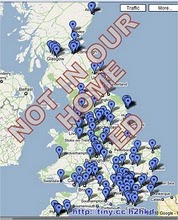
Is Badman back?
Recall the bloke - old-school and new school and every kind of school. He loved school, that man. That Badman. A few years back Mr. Badman seemed intent on making local authorities REALLY responsible for children's education. Not that some parents would mind - they'd thoroughly enjoy suing the shorts off LAs for the massive LACK of education that some LAs deliver to some children.
Mr. B. wanted to make home education into schooling. It was a mission set for him by Ed. Balls,. Education Secretary.at the time.
But like all ill-conceived ideas, this one has unleashed the furies of hell for some families. The dreadful duo encouraged, aided and abetted law avoiding local authorities (and why has their name changed from councils to authorities? Probably because a local authority sounds far more threatening than a local council, doesn't it?) in - well - avoiding the law where home education is concerned.
One pillar that society rests on is that parents are responsible for their children's education. Most parents think that the state is and that children MUST GO TO SCHOOL!!!! But, in fact, children can be educated anywhere and by anyone. Yes, even by themselves. And that's because the state is not legally responsible for providing an education for a ham sandwich (or a child).
Hum, hum, though, local authorities keep pushing at the door which will swing back and annihilate them. If they succeed in becoming responsible for home educating children's education then they will become responsible for school children's education. Considering the complete mess that is the hotch-potch curriculum, the boring and disagreeable school tasks, the lack of freedom to learn what you want, the disillusioned and over-stressed teachers, the bullied hordes and the disengaged youth we see in our marvellous state-run schools, I wouldn't be too keen to throw my hands in the air and say, "Lookee, here, kids, it's MY FAULT that you haven't been educated." What a veritable tranche of lawsuits we could look forward to. How many youngsters would gleefully learn about the law to pursue (and sue) the LAs.
You can just see it, can't you? The floodgates would open, the deluge equivalent to the biblical waters overwhelming the world would - er - overwhelm the world, and LAs would be toast. Sodden toast.
Nikki Harper says it very well here:
http://www.huffingtonpost.co.uk/nikki-harper/ultra-vires-home-educatio_b_1538723.html?ref=uk
Why shouldn't we listen to LAs who are panting to be responsible for every child's education?
Simply because they are wrong. In the legal quagmire. Up the spout without a paddle. Talking through their proverbial...
Right now, Mr. Badman, you can go away again.
Friday, 25 May 2012
Thursday, 17 May 2012
Deeds from the dark - Secret Family Courts UK
Filthy deeds could be done in the dark.
Scurrilous.
Dangerous.
We walk in fear across shaking sands. In the dark.
What am I talking about? What now?
The biggest fear a parent has. The loss of a child. The tearing away, ripping apart, rending the heart out of, death of all laughter, all light, all heart, most hideous blow, mind-blowing, mind-destroying, worst thing one human can do to another thing.
The losing of a child. A little human that you live for, that you'd die for, that you cry over when he falls over, that you cry over when he stands up, that human being who took shelter in your deepest dreams and took sustenance from your own body. He who grew inside your inside. Or she.
Your child. Or the child you planted in someone else. Someone who carried that excellent burden. The other parent.
To parent. To hope. To protect. To live and breathe for. To give life. To give life to keep the life safe to enjoy the life with the one who holds your life in his hands.
OK. What? What? What am I meaning? What?
Filthy deeds could thrive in the dark.
The deeds of agents of the state taking babies from mothers, little ones from fathers when the parents are dumfounded and made dumb by gags stuffed in their mouths and, if they speak, if they squeak at the treatment, they're jailed and they lose. They lose their children; they don't care about their freedom when they've lost their children because freedom isn't worth a toss if you don't spend its coinage on your children, is it?
http://www.whatdotheyknow.com/request/corruption_and_perjury_in_secret
Can you lose your child because a social worker doesn't like you? Thinks you can't look after your child? Sees that you home educate?
Can you?
How should we know? These courts are SECRET. In the dark. In the screaming fighting longing crying dying dark.
How do we know? Some speak out. Some say that no good thing goes on in closed courts shrouded in the dark of secrecy. Of silence. Of silenced parents and grandparents. Of screaming in pain silenced parents...
http://www.youtube.com/watch?v=8-c6ATb7DP8
The earliest courts, my daughter tells me, were set up in public, in the light, where you could go to mock or to look and seeeeee what went on.. They weren't held in the basement. They were out in the light in the day not the dark.
Why are these courts secret? Why? Why shouldn't we see? Why shouldn't we hear these PUBLIC servants speak to the silenced parents and grandparents?
WHY ARE THEY SECRET?
Open them up to the light, so we can see in the LIGHT. Let's bring in the light. Let's fight the dark. The darkness. Let's hold it up to the light.
Bob Geldof can see it: Here, see what he says:
"Relocation and Leave to Remove: A Report by The Custody Minefield
Foreword by Sir Bob Geldof. Published December 2009
I can hardly read the literature on Family Law without simultaneous feelings of an awful sadness and profound rage. Sadness at what has been done to our children and their families and deep rage for our Family Courts and the inadequate practitioners that work within it.
In the near future the Family Law under which we endure will be seen as barbaric, criminally damaging, abusive, neglectful, harmful to society, the family, the parents and the children in whose name it purports to act. It is beyond scrutiny or criticism and like a secret society its members – the judges, lawyers, social and child “care” agencies behave like any closed vested interest and protect each others’ backs.
The court is entirely informed by outdated social engineering models and contemporary attitudes rather than fact, precedent rather than common sense and modish unproven nostrums rather than present day realities. It is a disgraceful mess. A farrago of cod professionalism and faux concern largely predicated on nonsensical social guff, mumbo-jumbo and psycho-babble. Dangling at the other end of this are the lives of thousands of British children and their families.
Here is one more report that empirically nails the obvious fact that to remove a child from their father (in the hugely vast majority of cases), their grandparents and other family, their school and friends, is wholly destructive to a child and its family.
How much longer must we put up with the state sanctioned kidnap of our most vulnerable? Because in effect that’s what “Leave to Remove” amounts to. How much longer do we tolerate the vested interest intransigence of the appalling U.K. Family Justice system? How long before just one of them admit they have got it ALL wrong and apologise to their myriad victims?
This report is important, timely and vital. To accept its findings, which could have and should have, been conducted at any time in the past 30 years, is to accept the awful conclusion that rather than Solomon like resolving our tragically human disputes with understanding, compassion and logical pragmatism the courts have consistently acted against society’s interest through the application of prejudice, gender bias and awful impartial cruelty.
This report proves it. May God forgive them. I won’t.
Bob Geldof (December 2009)"
And, and, and why don't we spend the money that we spend on the whole pitiful dark process on really helping people to stay with their children, to be with their children. Maybe, if the parenting is broken, we can hold a hand out and, at least, try to keep the parents with the children. It has to be worth a shot.. Better than tearing ripping destroying the bond between a parent and a child; the deepest truest most incredible bond that there ever could be.
Why do we have to punish? Why can't we heal people? Why can't we put together? Why can't we put the light on? WHY?
Scurrilous.
Dangerous.
We walk in fear across shaking sands. In the dark.
What am I talking about? What now?
The biggest fear a parent has. The loss of a child. The tearing away, ripping apart, rending the heart out of, death of all laughter, all light, all heart, most hideous blow, mind-blowing, mind-destroying, worst thing one human can do to another thing.
The losing of a child. A little human that you live for, that you'd die for, that you cry over when he falls over, that you cry over when he stands up, that human being who took shelter in your deepest dreams and took sustenance from your own body. He who grew inside your inside. Or she.
Your child. Or the child you planted in someone else. Someone who carried that excellent burden. The other parent.
To parent. To hope. To protect. To live and breathe for. To give life. To give life to keep the life safe to enjoy the life with the one who holds your life in his hands.
OK. What? What? What am I meaning? What?
Filthy deeds could thrive in the dark.
The deeds of agents of the state taking babies from mothers, little ones from fathers when the parents are dumfounded and made dumb by gags stuffed in their mouths and, if they speak, if they squeak at the treatment, they're jailed and they lose. They lose their children; they don't care about their freedom when they've lost their children because freedom isn't worth a toss if you don't spend its coinage on your children, is it?
http://www.whatdotheyknow.com/request/corruption_and_perjury_in_secret
Can you lose your child because a social worker doesn't like you? Thinks you can't look after your child? Sees that you home educate?
Can you?
How should we know? These courts are SECRET. In the dark. In the screaming fighting longing crying dying dark.
How do we know? Some speak out. Some say that no good thing goes on in closed courts shrouded in the dark of secrecy. Of silence. Of silenced parents and grandparents. Of screaming in pain silenced parents...
http://www.youtube.com/watch?v=8-c6ATb7DP8
The earliest courts, my daughter tells me, were set up in public, in the light, where you could go to mock or to look and seeeeee what went on.. They weren't held in the basement. They were out in the light in the day not the dark.
Why are these courts secret? Why? Why shouldn't we see? Why shouldn't we hear these PUBLIC servants speak to the silenced parents and grandparents?
WHY ARE THEY SECRET?
Open them up to the light, so we can see in the LIGHT. Let's bring in the light. Let's fight the dark. The darkness. Let's hold it up to the light.
Bob Geldof can see it: Here, see what he says:
"Relocation and Leave to Remove: A Report by The Custody Minefield
Foreword by Sir Bob Geldof. Published December 2009
I can hardly read the literature on Family Law without simultaneous feelings of an awful sadness and profound rage. Sadness at what has been done to our children and their families and deep rage for our Family Courts and the inadequate practitioners that work within it.
In the near future the Family Law under which we endure will be seen as barbaric, criminally damaging, abusive, neglectful, harmful to society, the family, the parents and the children in whose name it purports to act. It is beyond scrutiny or criticism and like a secret society its members – the judges, lawyers, social and child “care” agencies behave like any closed vested interest and protect each others’ backs.
The court is entirely informed by outdated social engineering models and contemporary attitudes rather than fact, precedent rather than common sense and modish unproven nostrums rather than present day realities. It is a disgraceful mess. A farrago of cod professionalism and faux concern largely predicated on nonsensical social guff, mumbo-jumbo and psycho-babble. Dangling at the other end of this are the lives of thousands of British children and their families.
Here is one more report that empirically nails the obvious fact that to remove a child from their father (in the hugely vast majority of cases), their grandparents and other family, their school and friends, is wholly destructive to a child and its family.
How much longer must we put up with the state sanctioned kidnap of our most vulnerable? Because in effect that’s what “Leave to Remove” amounts to. How much longer do we tolerate the vested interest intransigence of the appalling U.K. Family Justice system? How long before just one of them admit they have got it ALL wrong and apologise to their myriad victims?
This report is important, timely and vital. To accept its findings, which could have and should have, been conducted at any time in the past 30 years, is to accept the awful conclusion that rather than Solomon like resolving our tragically human disputes with understanding, compassion and logical pragmatism the courts have consistently acted against society’s interest through the application of prejudice, gender bias and awful impartial cruelty.
This report proves it. May God forgive them. I won’t.
Bob Geldof (December 2009)"
And, and, and why don't we spend the money that we spend on the whole pitiful dark process on really helping people to stay with their children, to be with their children. Maybe, if the parenting is broken, we can hold a hand out and, at least, try to keep the parents with the children. It has to be worth a shot.. Better than tearing ripping destroying the bond between a parent and a child; the deepest truest most incredible bond that there ever could be.
Why do we have to punish? Why can't we heal people? Why can't we put together? Why can't we put the light on? WHY?
Monday, 7 May 2012
May Day
May. May I? May I say? May Day. There's a day in May that's important to me. There are two important May Days. Birthday days.
Why are birthdays so important?
I think it's to check your progress. To take your emotional temperature. To see where you are in the thickets of life, and climb a tree to spy out the path, if there is one.
Important days, birthdays. You find out who your friends are. You find out which of your friends have good memories. You find out which friends decide that your birthday is important enough to mark with a card or a cheery email.
Or not.
Have I made some progress since last birthday? What is progress? What do I mean by progress? Can progress be measured? Is it something I can test? Is it something I should test? And should I ask so many questions or should I be quiet and just be?
What have I done since last birthday?
Have I done what I wanted to do before this birthday?
Has life handed me a fistful of lemons and have I filled a whole row of bottles with lemonade? And did I sell the lemonade or have I thrown the bottles out? (Or recycled them?)
I'm still feeling idle curiosity so I'll just say I'm not even going to examine those questions.
And I don't like lemonade or cute slogans anyway.
Let's just live May to the fullest and drain its goodness to the last drop.
May your month be pleasant.
Why are birthdays so important?
I think it's to check your progress. To take your emotional temperature. To see where you are in the thickets of life, and climb a tree to spy out the path, if there is one.
Important days, birthdays. You find out who your friends are. You find out which of your friends have good memories. You find out which friends decide that your birthday is important enough to mark with a card or a cheery email.
Or not.
Have I made some progress since last birthday? What is progress? What do I mean by progress? Can progress be measured? Is it something I can test? Is it something I should test? And should I ask so many questions or should I be quiet and just be?
What have I done since last birthday?
Have I done what I wanted to do before this birthday?
Has life handed me a fistful of lemons and have I filled a whole row of bottles with lemonade? And did I sell the lemonade or have I thrown the bottles out? (Or recycled them?)
I'm still feeling idle curiosity so I'll just say I'm not even going to examine those questions.
And I don't like lemonade or cute slogans anyway.
Let's just live May to the fullest and drain its goodness to the last drop.
May your month be pleasant.
Sunday, 29 April 2012
Idleness becomes us
Have you noticed just how much you accomplish while you are idle?
I mean those times when you've kicked the tight shoes off, tucked your feet underneath you on your comfy seat, and done absolutely nothing?
I mean nothing.
You're not being unworthy or wrong or naughty. You are just being.
Don't the good ideas spring from wells of idle thought? The worthiest of new plans are laid whilst you lie about.
Here is a foundation that agrees with me, the NEF:
"Just think how much more congenial life would be if all of us worked less and some did no work at all. Oh, for a life of idle politicians, torpid bureaucrats, silent and inert celebrities, and listless pressure groups. Truly, the devil makes work for busy hands.
The notion of working less and mooching more is endorsed by the New Economics Foundation (NEF), which argues the case for a 21-hour working week. There is nothing, it says, natural or inevitable about a 'normal' 40-hour week whose pernicious effect is a vicious cycle of work and consumption. People live to work, work to earn, and earn to consume.
'A much shorter working week would change the tempo of our lives, reshape habits and conventions, and profoundly alter the dominant cultures of western society' it adds.
I'm quoting from Mr. Iain Murray who is writing the column entitled 'Funny Money' in the Money Observer magazine (May 2012).
He and the NEF are right, of course. But do modern societies want to be altered and made better for the heaving millions of us who aren't rich enough to down tools and downgrade? I would think not because from CEEFAX today came the news I've actually been watching for and now I've found it again:
"The UK's richest people have defied the double-dip recession to become even richer over the past year, according to the annual Sunday Times Rich List.
The newspaper's research found the combined worth of the country's 1,000 wealthiest people is £414bn, up 4.7%.
It means their joint wealth has passed the level last seen in 2008, before the financial crash, to set a new record."
http://www.bbc.co.uk/news/business-17885570
The already wealthy small minority of us have got wealthier. Quel surprise!
And don't be concerned about the rich brigade having their wealth snatched away any time soon. The Chancellor, Mr. George Osborne, is reducing the amount of tax they'll be paying in future.
OK, now you can get back to work, you slackers!
I mean those times when you've kicked the tight shoes off, tucked your feet underneath you on your comfy seat, and done absolutely nothing?
I mean nothing.
You're not being unworthy or wrong or naughty. You are just being.
Don't the good ideas spring from wells of idle thought? The worthiest of new plans are laid whilst you lie about.
Here is a foundation that agrees with me, the NEF:
"Just think how much more congenial life would be if all of us worked less and some did no work at all. Oh, for a life of idle politicians, torpid bureaucrats, silent and inert celebrities, and listless pressure groups. Truly, the devil makes work for busy hands.
The notion of working less and mooching more is endorsed by the New Economics Foundation (NEF), which argues the case for a 21-hour working week. There is nothing, it says, natural or inevitable about a 'normal' 40-hour week whose pernicious effect is a vicious cycle of work and consumption. People live to work, work to earn, and earn to consume.
'A much shorter working week would change the tempo of our lives, reshape habits and conventions, and profoundly alter the dominant cultures of western society' it adds.
I'm quoting from Mr. Iain Murray who is writing the column entitled 'Funny Money' in the Money Observer magazine (May 2012).
He and the NEF are right, of course. But do modern societies want to be altered and made better for the heaving millions of us who aren't rich enough to down tools and downgrade? I would think not because from CEEFAX today came the news I've actually been watching for and now I've found it again:
"The UK's richest people have defied the double-dip recession to become even richer over the past year, according to the annual Sunday Times Rich List.
The newspaper's research found the combined worth of the country's 1,000 wealthiest people is £414bn, up 4.7%.
It means their joint wealth has passed the level last seen in 2008, before the financial crash, to set a new record."
http://www.bbc.co.uk/news/business-17885570
The already wealthy small minority of us have got wealthier. Quel surprise!
And don't be concerned about the rich brigade having their wealth snatched away any time soon. The Chancellor, Mr. George Osborne, is reducing the amount of tax they'll be paying in future.
OK, now you can get back to work, you slackers!
Wednesday, 4 April 2012
This and that and vulnerable people and benefits
I completely forgot my email address. No, I did. Shamefacedly, I had to ask my eldest who, of course, told me immediately. It's fortunate that something so important as education doesn't rely on good memory, isn't it? Or... wait... it does. What else are exams but a test of memory?
Anyway, I recall I wanted to natter about something else. It's this:
http://newsnetscotland.com/index.php/scottish-opinion/4709-the-case-for-the-vulnerable-in-scottish-society
That was posted in the home educating business forums and thanks to A.P. for finding it.
A quotation from it:
"I am not going to speak for any of my friends here, but I am going to cite the case of the treatment our family received from our local LEA. Our son was diagnosed with Asperger's syndrome when he was eight years old. We had already withdrawn him from our local school after Primary 1 because he was having clear difficulties that the school were putting down to bad behaviour. If I were to be truly honest, we were left feeling that we were to blame for his poor behaviour as being bad parents."
Oh, the first rule of schools and LAs - blame the vulnerable or, even better, blame the parents of the vulnerable. It's the same in the rest of society. You're poor? It must be your own fault so you shall be punished by removal of basic subsistence levels of income. You're fat? You should cut down on the cream cakes and jog six miles every morning even though your parents and grandparents were all full moon-shaped and the latest (apparently surprising) scientific evidence tells us that we may indeed take after our ancestors and turn out to be full moon-shaped too)... I digress.
Back to the topic.
A friend's son, J, once got called into the head teacher's office for some minor disobedience (a healthy sign in the young, I think) and had the following shouted in his face: "YOU JUST HAVE BAD PARENTS!"
Putting aside the extremely poor manners and threatening behaviour of the head, he was just plain wrong. J's mother and father are completely involved and amazingly good parents. But the point is that schools love to shift blame which is a pretty useless way of dealing with any problem (or a successful tack to avoid dealing with any problem).
We shouldn't have an adversarial position in schools. Basically the ideology is that teachers, parents and students and support staff and politicians and Uncle Tom Cobbley and all are involved in or have a stake in a student's education (or schooling) and we, and they, should all work together because we all have a stake in a student becoming an educated being or, at least, schooled.
That WAS a long sentence. I'm quite puffed out. Of course, the ideology is quite misleading and teachers blame parents who blame teachers and... well, you know the spiel well enough. No one takes responsibility, do they? And no one quite seems to realise that you CANNOT FORCE ANYONE TO LEARN ANYTHING. (I'm not shouting at you. It seemed too important not to put into capitals).
"When he came to Secondary age we all decided to give the School a second chance, as my son is very keen on Science and we lack a laboratory. We took the long approach and contacted the LEA an entire year in advance of his joining S1, and tried to use that opportunity to describe his needs to the School so they could be able to deal with him sensibly."
Yes, well, I would've hired the local secondary school's lab or built one in a shed in the back garden. Many brilliant discoveries have been made in sheds or basements all over our fine planet.
And did the LA (LEA) respond to this challenge from responsible and sensible parents? Aye, indeed (I just have fallen in love with the word 'indeed' indeed).
Not.
After a battery of hoops to be jumped through, this:
"Next our son had to undertake a series of tests with the (new) Educational Psychologist, to prove once again that there were areas in which he both had difficulty with and others were he excelled. Then there were more meetings, and the school was still not prepared to meet the things we had asked for. Our son attended some of the induction days. We had more meetings, complaints had to be made about the conduct of the staff at some of these meetings as things were beginning to become highly stressful for us with the schools continuing intransigence."
They love their meetings these institutions, don't they? When in doubt, have a meeting. When not in doubt have a meeting. Meetings solve everything, don't they?
"The year he was in S1 contained so many disasters that to list them here would be both tedious, draining and, frankly, personally upsetting. Our son was repeatedly accused of bad behaviour and the school repeatedly blame us for imposing "preferential" treatment for him. We went as far as to take out an FOI on his records, place formal complaints, take those complaints to the council's Corporate Complaints dept., get sick lines from the doctor because our son was becoming increasingly anxious with every day at school and to attend mediated meetings where nothing constructive ever took place."
What did I say about those meetings?
The point, I think, about this blog post is to say that no institution will meet the needs of every one person. I'm sorry but I think that institutions are not there to meet the needs of their users. I think that institutions are there to perpetuate themselves and blame the victims of their machinations.
This concerned mother says:
"It ended with an ultimatum from the school that we either send our son full-time, part-time to their timetable or to withdraw him from school again. By this point we were going through the process of talking to a child psychologist and a neurologist about our son and they both agreed that the classroom environment was an unhealthy one for our son. They recommended we went back to home education, which is exactly what we did.
This was not the end of the process, as we now had to deal with the de-registration process, which was a trial in itself this time. Last time we did it we withdrew Alex over the course of one summer and it was actually painless. This time we had to meet a social worker and an officer from the LEA to approve our request.
The number of people we have had to explain our son to has been phenomenal, but worse still is the number of so-called professionals that have failed to listen to our advice about our son has been nothing short of criminal.
We are not alone, we are not unique. The heavy weight of the hand of the state on it's vulnerable members is not currently a source for good at all, but a source for great stress and worsening of many problems. If you take the case for not extraditing Gary McKinnon, a large part of it hinges on the possibility of the likliehood of introducing psychosis to Gary because sufferer's of Asperger's and ASD are much more prone to such things while under stress than other people.
The UK Government wants to make this harder for vulnerable people. They will want to put my son into a work placement when he is older, and we cannot trust them not to send him somewhere where his problems will be exacerbated.
The UK Government wants to assess whether terminally ill people should be assessed to see if they are fit for work. The UK Government plans to introduce big changes to DLA for children. The UK Government plans all in a timeline that runs all the way through the referendum campaign up until 2016.
These benefit changes are utterly unwelcome and frankly cruel, and we can avoid them by gaining our Independence from such toxic Westminster policies. The economic argument is familiar but the social democratic argument is becoming clearer.
We need to have Scotland's future in Scotland's hands to redress the awful damage the current system does to our vulnerable people. We have to opportunity to bring some sanity and unity to the process of helping our vulnerable people. That's good enough for me to vote yes."
If I were living in Scotland the treatment of vulnerable people living in a rich capitalist money-worshipping uncaring society would worry me and I'd probably vote to leave the United States of Britain. Since I'm living in England I just worry about vulnerable people living in a rich capitalist money-worshipping uncaring society in each and all of the United States of Britain. Or anywhere.
We have the power. We are a large number of people who have power. Why do we put up with these people in so-called power? Have we lost any sense of charity towards other folks who are not as well off as we are? Have we lost any sense of charity towards anyone? Is it all cuts and making it harder for those who haven't been supported by rich parents and wealthy families? Is this what we have been reduced to?
Is it?
Anyway, I recall I wanted to natter about something else. It's this:
http://newsnetscotland.com/index.php/scottish-opinion/4709-the-case-for-the-vulnerable-in-scottish-society
That was posted in the home educating business forums and thanks to A.P. for finding it.
A quotation from it:
"I am not going to speak for any of my friends here, but I am going to cite the case of the treatment our family received from our local LEA. Our son was diagnosed with Asperger's syndrome when he was eight years old. We had already withdrawn him from our local school after Primary 1 because he was having clear difficulties that the school were putting down to bad behaviour. If I were to be truly honest, we were left feeling that we were to blame for his poor behaviour as being bad parents."
Oh, the first rule of schools and LAs - blame the vulnerable or, even better, blame the parents of the vulnerable. It's the same in the rest of society. You're poor? It must be your own fault so you shall be punished by removal of basic subsistence levels of income. You're fat? You should cut down on the cream cakes and jog six miles every morning even though your parents and grandparents were all full moon-shaped and the latest (apparently surprising) scientific evidence tells us that we may indeed take after our ancestors and turn out to be full moon-shaped too)... I digress.
Back to the topic.
A friend's son, J, once got called into the head teacher's office for some minor disobedience (a healthy sign in the young, I think) and had the following shouted in his face: "YOU JUST HAVE BAD PARENTS!"
Putting aside the extremely poor manners and threatening behaviour of the head, he was just plain wrong. J's mother and father are completely involved and amazingly good parents. But the point is that schools love to shift blame which is a pretty useless way of dealing with any problem (or a successful tack to avoid dealing with any problem).
We shouldn't have an adversarial position in schools. Basically the ideology is that teachers, parents and students and support staff and politicians and Uncle Tom Cobbley and all are involved in or have a stake in a student's education (or schooling) and we, and they, should all work together because we all have a stake in a student becoming an educated being or, at least, schooled.
That WAS a long sentence. I'm quite puffed out. Of course, the ideology is quite misleading and teachers blame parents who blame teachers and... well, you know the spiel well enough. No one takes responsibility, do they? And no one quite seems to realise that you CANNOT FORCE ANYONE TO LEARN ANYTHING. (I'm not shouting at you. It seemed too important not to put into capitals).
"When he came to Secondary age we all decided to give the School a second chance, as my son is very keen on Science and we lack a laboratory. We took the long approach and contacted the LEA an entire year in advance of his joining S1, and tried to use that opportunity to describe his needs to the School so they could be able to deal with him sensibly."
Yes, well, I would've hired the local secondary school's lab or built one in a shed in the back garden. Many brilliant discoveries have been made in sheds or basements all over our fine planet.
And did the LA (LEA) respond to this challenge from responsible and sensible parents? Aye, indeed (I just have fallen in love with the word 'indeed' indeed).
Not.
After a battery of hoops to be jumped through, this:
"Next our son had to undertake a series of tests with the (new) Educational Psychologist, to prove once again that there were areas in which he both had difficulty with and others were he excelled. Then there were more meetings, and the school was still not prepared to meet the things we had asked for. Our son attended some of the induction days. We had more meetings, complaints had to be made about the conduct of the staff at some of these meetings as things were beginning to become highly stressful for us with the schools continuing intransigence."
They love their meetings these institutions, don't they? When in doubt, have a meeting. When not in doubt have a meeting. Meetings solve everything, don't they?
"The year he was in S1 contained so many disasters that to list them here would be both tedious, draining and, frankly, personally upsetting. Our son was repeatedly accused of bad behaviour and the school repeatedly blame us for imposing "preferential" treatment for him. We went as far as to take out an FOI on his records, place formal complaints, take those complaints to the council's Corporate Complaints dept., get sick lines from the doctor because our son was becoming increasingly anxious with every day at school and to attend mediated meetings where nothing constructive ever took place."
What did I say about those meetings?
The point, I think, about this blog post is to say that no institution will meet the needs of every one person. I'm sorry but I think that institutions are not there to meet the needs of their users. I think that institutions are there to perpetuate themselves and blame the victims of their machinations.
This concerned mother says:
"It ended with an ultimatum from the school that we either send our son full-time, part-time to their timetable or to withdraw him from school again. By this point we were going through the process of talking to a child psychologist and a neurologist about our son and they both agreed that the classroom environment was an unhealthy one for our son. They recommended we went back to home education, which is exactly what we did.
This was not the end of the process, as we now had to deal with the de-registration process, which was a trial in itself this time. Last time we did it we withdrew Alex over the course of one summer and it was actually painless. This time we had to meet a social worker and an officer from the LEA to approve our request.
The number of people we have had to explain our son to has been phenomenal, but worse still is the number of so-called professionals that have failed to listen to our advice about our son has been nothing short of criminal.
We are not alone, we are not unique. The heavy weight of the hand of the state on it's vulnerable members is not currently a source for good at all, but a source for great stress and worsening of many problems. If you take the case for not extraditing Gary McKinnon, a large part of it hinges on the possibility of the likliehood of introducing psychosis to Gary because sufferer's of Asperger's and ASD are much more prone to such things while under stress than other people.
The UK Government wants to make this harder for vulnerable people. They will want to put my son into a work placement when he is older, and we cannot trust them not to send him somewhere where his problems will be exacerbated.
The UK Government wants to assess whether terminally ill people should be assessed to see if they are fit for work. The UK Government plans to introduce big changes to DLA for children. The UK Government plans all in a timeline that runs all the way through the referendum campaign up until 2016.
These benefit changes are utterly unwelcome and frankly cruel, and we can avoid them by gaining our Independence from such toxic Westminster policies. The economic argument is familiar but the social democratic argument is becoming clearer.
We need to have Scotland's future in Scotland's hands to redress the awful damage the current system does to our vulnerable people. We have to opportunity to bring some sanity and unity to the process of helping our vulnerable people. That's good enough for me to vote yes."
If I were living in Scotland the treatment of vulnerable people living in a rich capitalist money-worshipping uncaring society would worry me and I'd probably vote to leave the United States of Britain. Since I'm living in England I just worry about vulnerable people living in a rich capitalist money-worshipping uncaring society in each and all of the United States of Britain. Or anywhere.
We have the power. We are a large number of people who have power. Why do we put up with these people in so-called power? Have we lost any sense of charity towards other folks who are not as well off as we are? Have we lost any sense of charity towards anyone? Is it all cuts and making it harder for those who haven't been supported by rich parents and wealthy families? Is this what we have been reduced to?
Is it?
Labels:
force and education,
memory,
UK government policies
Friday, 16 March 2012
In the march
I had a bit of a flubber there and thought I'd missed most of March. It's a month I used to ignore and just let pass by without comment and with relative indifference. These years it's a month I feel fond of. A liminal month, not quite winter and not yet summer. Perhaps it's spring? Perhaps not. March, in short, is me personified. I'm here, and every year I'm different. Some years I'm raring to go and full of the joys of, and other years I want the duvet pulled firmly over my aching head.
This March, this year, I keep seeing potential everywhere. I see potential spring. I note the graceful beauty of snowdrops competing with the divinity of daffodils. I watch as the barren brown branches of winter burst into brilliant blossom. I thrill to the colours enhanced by the return of the sun. I feel like a spring lamb, leapy and joyous, and all things are possible it seems.
I think the difference this year is that I 'get' home education. It's the very breath and pulse of freedom. It's the sheer exultation of learning. It's the bounce and leap of doing your own things and watching your own things getting better and better and more and more.
A friend quizzed me last night on how my child will get into university. "But has she done A levels?"
"She's done a certificate that equals three A levels."
On her face there was blank incomprehension. How could one vault over A levels? How could one do a University course to prove one is ready to - er - do a University course? Wouldn't a person who didn't fit the pattern, who wasn't made to measure, be unacceptable?
No. A university will offer a place because the people there have reason to believe that the student is capable of studying a course and is enthusiastic about that course.
If any university turns down a student on grounds other than those criteria... Well, would a bright-minded, independent thinker actually want to waste time there? Would you?
We have to go to school. No, we don't.
We have to 'do' exams. No, we don't.
We have to follow our dreams, respect our natures and our talents. Yes, we do.
And, if all else fails, there's the University of Life from which we - sooner or later - will graduate.
This March, this year, I keep seeing potential everywhere. I see potential spring. I note the graceful beauty of snowdrops competing with the divinity of daffodils. I watch as the barren brown branches of winter burst into brilliant blossom. I thrill to the colours enhanced by the return of the sun. I feel like a spring lamb, leapy and joyous, and all things are possible it seems.
I think the difference this year is that I 'get' home education. It's the very breath and pulse of freedom. It's the sheer exultation of learning. It's the bounce and leap of doing your own things and watching your own things getting better and better and more and more.
A friend quizzed me last night on how my child will get into university. "But has she done A levels?"
"She's done a certificate that equals three A levels."
On her face there was blank incomprehension. How could one vault over A levels? How could one do a University course to prove one is ready to - er - do a University course? Wouldn't a person who didn't fit the pattern, who wasn't made to measure, be unacceptable?
No. A university will offer a place because the people there have reason to believe that the student is capable of studying a course and is enthusiastic about that course.
If any university turns down a student on grounds other than those criteria... Well, would a bright-minded, independent thinker actually want to waste time there? Would you?
We have to go to school. No, we don't.
We have to 'do' exams. No, we don't.
We have to follow our dreams, respect our natures and our talents. Yes, we do.
And, if all else fails, there's the University of Life from which we - sooner or later - will graduate.
Labels:
learning freedom,
spring,
university
Tuesday, 6 March 2012
A teacher's learned wisdom
A teacher writing a letter to the Writer's Forum magazine has discovered a truth that all home educators know or find out early in their home education journeys.
"Putting ownership and choice into our teaching of writing may just be the trick to creating our next generation of imaginative and happy writers."
Given the difficult ordeal of trying to make children write and read, teacher Fran Slimon decided to consult her class about what they would like to write. Their response was warm and accepting as they rushed into the classroom to find out which of their preferred topics had been selected for their attention.
It's surprising how few teachers realise the simple fact that you cannot force anyone to learn anything. You cannot make them love writing or reading. I believe that we are all programmed to learn to write and read but that we retard these natural assets by thinking that adults must and should direct the functions.
We think that children will not learn to love reading and writing and they must be made to read and write. How can you learn something which is forced on you? How can the natural course of events unfold unless you are left to uncover the treasures that reading and writing bestow in your life? How will reactance (a psychological response to removing freedom of action for an individual) not surface if you are pushing and shoving a child to do what that child is not ready for or doesn't wish to do?
Well done Ms Slimon. You have seen what is so clear. People do best what they choose to do, and, in the great majority of cases, people choose wisely.
"Putting ownership and choice into our teaching of writing may just be the trick to creating our next generation of imaginative and happy writers."
Given the difficult ordeal of trying to make children write and read, teacher Fran Slimon decided to consult her class about what they would like to write. Their response was warm and accepting as they rushed into the classroom to find out which of their preferred topics had been selected for their attention.
It's surprising how few teachers realise the simple fact that you cannot force anyone to learn anything. You cannot make them love writing or reading. I believe that we are all programmed to learn to write and read but that we retard these natural assets by thinking that adults must and should direct the functions.
We think that children will not learn to love reading and writing and they must be made to read and write. How can you learn something which is forced on you? How can the natural course of events unfold unless you are left to uncover the treasures that reading and writing bestow in your life? How will reactance (a psychological response to removing freedom of action for an individual) not surface if you are pushing and shoving a child to do what that child is not ready for or doesn't wish to do?
Well done Ms Slimon. You have seen what is so clear. People do best what they choose to do, and, in the great majority of cases, people choose wisely.
Labels:
freedom to choose,
teaching writing,
Writer's Forum
Subscribe to:
Posts (Atom)